


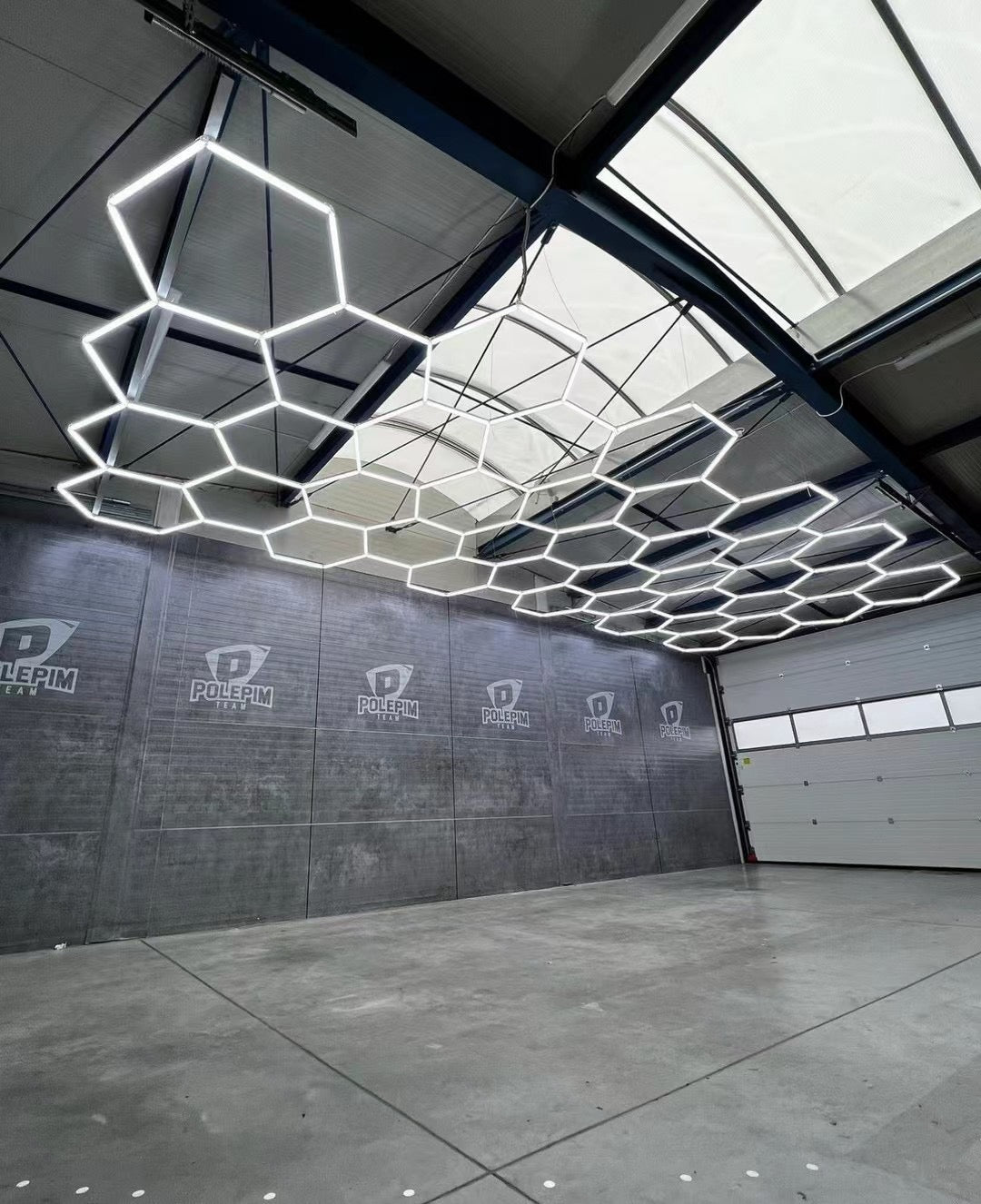
Discover why hex lights are becoming the top choice for detailing shops. We compare hexagon lighting with traditional garage lights and show how to make the most out of your lighting setup.
Professional detailers rely on hex lights for detailing shops that deliver consistent, shadow-free coverage across every panel they work on.
Yes. A hex grid spreads light evenly over the whole car, so you get fewer shadows and hot spots than you would with a few rows of tube lights. The grid shows up as clean lines in the paint, and you can use those lines to check your work.
1. Common Lighting Challenges in Detailing Shops
Many detailing shops still rely on outdated fluorescent tubes or low-end LED bulbs. These often create uneven brightness, glare, and dull lighting, making it hard for technicians to spot swirl marks or achieve precision. Poor lighting also undermines customer perception and weakens your brand image.

2. Why Hexagon Lights Are Becoming a Trend
Hex lights have quickly become the new standard in modern detailing shops. Their honeycomb structure provides consistent illumination across wide workspaces. Unlike single-point bulbs, hexagon lighting spreads brightness evenly, reducing shadows and eliminating hotspots. As a result, more shop owners are shifting to hexagon LED lights to boost both efficiency and aesthetics.

3. Hexagon Lights vs Traditional Lights
| Feature | Traditional Tube Lights | Hexagon Lights |
|---|---|---|
| Brightness | Uneven, dim spots | Evenly distributed, high lumen |
| Aesthetics | Basic and dated | Modern, high-tech appearance |
| Installation Flexibility | Fixed fixtures only | Modular, scalable design |
| Cost-Efficiency | Lower initial cost | Higher upfront, better ROI |
Will Hex Lights Cause Glare or Get in Your Way?
It's a fair question. Glare wears out your eyes on a long job, and anything that bounces off clear coat can get in the way when you're trying to read the paint.
Glare mostly comes from small, very bright points of light in your line of sight. Think of a bare bulb or a single clamp light. A hex grid works the other way. The light is spread across dozens of tubes over the whole ceiling, and every tube sits behind a polycarbonate diffuser that softens the LEDs inside. The grid is also overhead, so it stays above your eye line while you're working a panel.
Then there's the reflection. The grid does show up in glossy paint as a pattern of clean lines, and for detail work that's usually a plus. Move your head so a line slides across the panel, and swirls, holograms and high spots stand out against it. If the pattern bothers you on a final check, our team suggests looking at the panel from a few angles or using a handheld light.
Long days are easier too. Our lights are flicker-free, and with the dimmable version you can drop from 100% to 60% or 30% when you don't need full brightness, like during cleanup or when a customer comes to pick up.
4. How to Choose the Right Hex Light
Choosing the ideal setup depends on your garage or shop size. Explore our hex light range for standard configurations. For shops with specific lighting preferences like dimmable brightness, we also offer dimmable hex led lights series with 3-level dimming (100%, 60%, 30%) from a standard wall switch. For custom spaces or branding needs, visit our hex lights custom request page.

5. Easy Installation Guide
HEXLED lighting systems are designed for easy DIY installation. All packages come with detailed guides, plug-and-play connectors, and accessories. Whether you’re setting up on ceilings or walls, our system ensures minimal fuss and maximum performance. Watch our detailed installation guide or view the demo video below.
Here’s a short customer showcase of the finished setup:
See how professional detailing lights are helping shops deliver paint correction results that justify premium pricing.
6. Why Choose HEXLED Lighting
While hexagon lights in general offer great performance, our HEXLED products go beyond. Designed specifically for professional detailing needs:
- ✅ Built with aluminum housings for better heat dissipation
- ✅ Grounded 3-pin connections for enhanced safety
- ✅ Soft polycarbonate diffuser for low-glare visual comfort
- ✅ Long-lasting lifespan: rated for 50,000+ hours
- ✅ Fuse-protected power input and flame-retardant materials

Frequently Asked Questions
Are hex lights distracting when you're detailing?
They shouldn't be. The grid sits overhead, each tube has a diffuser, and the light is spread across the ceiling instead of a few bright points. The reflection in the paint can actually help, because swirls and high spots stand out against the lines.
Why do tint and wrap shops use hex lights?
Even overhead light makes dust, bubbles and lifted edges easier to see while you lay film. A hex ceiling also looks sharp in the photos and videos you post of finished cars.
Can I dim hex lights in a detailing shop?
Yes, if you order the dimmable version. It steps through 100%, 60% and 30% from a regular wall switch. It's hardwired to that switch, so plan on a licensed electrician for the connection.
How do I pick the right size for my bay?
Start with our guide on how many lumens a garage needs, which has targets for home detailing (130 to 180 lm per sq ft) and pro correction work (200 to 360 lm per sq ft). A 400 sq ft two-car bay, for example, needs about 60,000 lumens for home detailing, which is roughly what a 23 Grid puts out. Or send the HEXLED team your bay size and ceiling height, and we'll suggest a layout.
Ready to transform your detailing shop with professional-grade hex lights? Explore the full range today and elevate your workspace like never before. Contact us at info@hexledlighting.com to get started.